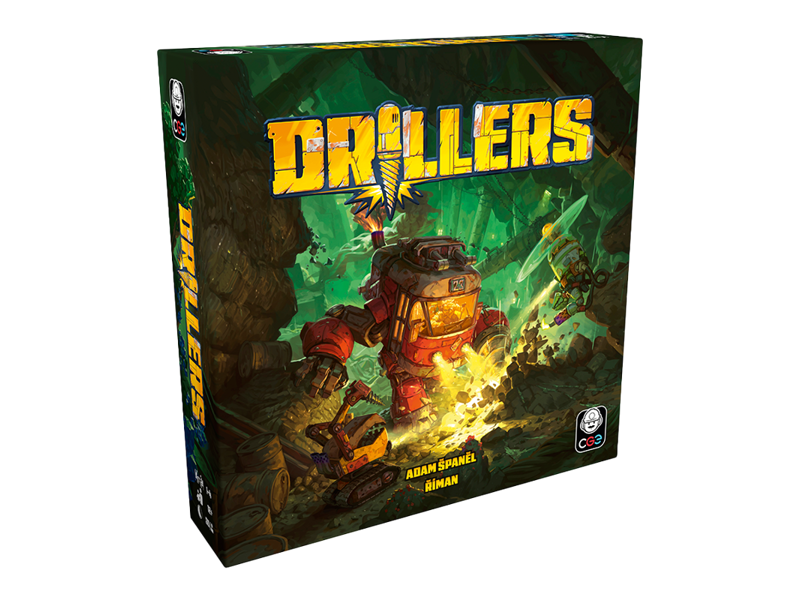
Drillers
review by Luka
What is Drillers?
Drillers is a deck-building game where players dig into the abandoned mines of an alien planet with their drilling mech to competitively and aggressively mine the most valuable minerals. The deeper players dig, more valuable resources are available to collect by the player that unlocks those deeper levels, and by all other players wishing to capitalize on the opportunity. Selling these minerals at the surface, they can make money and spend it to improve their mech fuel capacity, mineral storage, and mech deck by removing inefficient cards and adding new ones purchased from the market. However, dig too deep, and you may not have enough fuel to return to the surface to sell minerals and refuel. Once the planet has been hollowed out, the crust collapses and the miners must escape the mines! Whoever scores the most points by excavating the planet and collecting minerals wins the game. Will you be the one to best manage your fuel and cards, adapting to your opponents’ choices to be the #1 Driller?
Game Setup
While the amount of components may be a bit intimidating upon a glance, the set up is not too difficult to get to grips with. Much of the set up involves keeping the correct components together in the right stacks: utility cards for the market in one stack, barrier mine tiles on each proper floor, corridor mine tiles of the same size stacked, etc. Each player also receives their own components including a dashboard, three gauge indicators, three drone tokens, their mech, their starting deck, etc. Additionally, the game’s box has an insert that holds the mine tiles, the mechs, and the minerals. To organize the remaining components, all you need is a few bags. This helps streamline the game setup and storage without pressuring you to buy a box organizer.
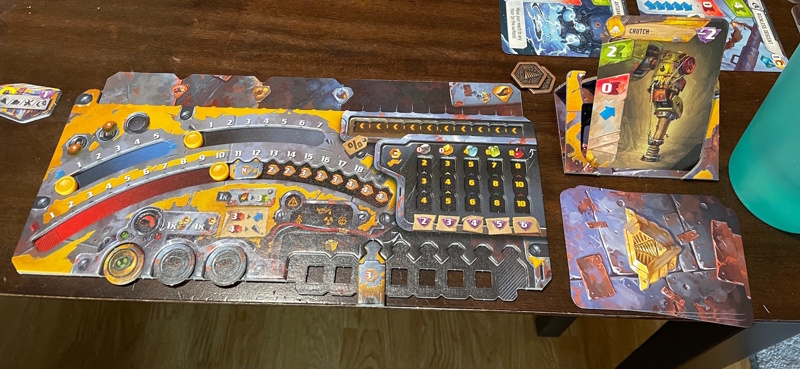 The player area set up.
I will warn that you’ll need a decent amount of space for the game, however. We barely made a 30”x50” table work.
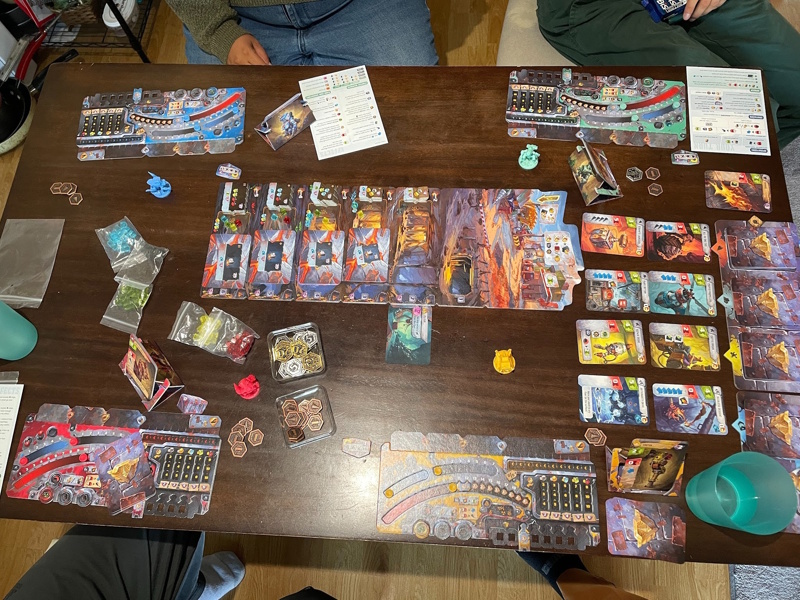 The entire game set up.
Gameplay Overview
In Drillers, players take turns until the end of the game is triggered, after which points are counted up and a victor is declared. Each player turn consists of three phases:
- Operations
- Surfacing
- Upkeep
Operations
This phase is the most impactful phase of a player's turn. During this phase, players use fuel to move, drill, and play cards, and they can use helpful drones that enable the execution of two different Surfacing phase actions (explained later). This is the phase of the turn where the player will be most active under the surface of the planet. The active player will keep performing actions until they decide to end the Operations phase, which will move their turn to the Surfacing phase.
Movement:
Players can gain movement either by playing cards or by directly spending fuel for movement (three fuel for one movement). When gaining movement, it does not need to be spent immediately; players can keep track of how much movement they’ve accumulated in a turn using their dashboard’s gauge. Then, when a player wishes to enter an open floor (one without a barrier tile), they can spend what they've got to do so. Every “movement point” spent allows players to move up or down a floor. Each floor is labeled, with 0 being the surface, 1 being the entrance to the mines, 2 being the first floor of the mines with minerals, and so on down to 6. If a player wishes to move to floor 3 from floor 0, they must spend three movement to do so, one for each floor. And after drilling on the floor 3, if they wish to return to floor 0, they must spend another 3 movement.
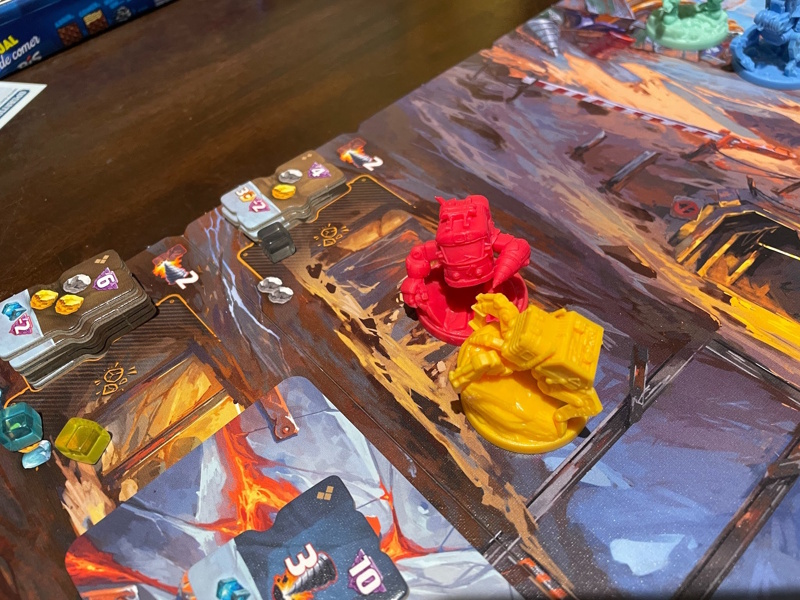 Player mechs that have moved into the same floor.
Drilling:
Players accumulate “drill points” much the same way they do movement: they gain them from cards or spending fuel (four fuel for one drill), and they keep track of the drill points gained using their player dashboard as well, and spend as needed during the operation phase. The main difference is that there are many more actions that are possible with the drill action. These include the following:
- Collect Minerals: for one drill point each, a player can pick up a mineral present on their floor. These get added to their storage. Once their storage is full, they cannot pick up more minerals.
- Excavate Corridor: sometimes, drilling the corridor mine tile of your current floor will yield more points than the minerals present, or perhaps there’s no minerals present on the floor you’re at. If that’s the case, and corridor mine tiles still remain on the floor, players can spend a number of drill points to excavate the corridor. Doing so adds the tile to the top of the player's dashboard, (known as the progress track). Minerals are then added to the floor, with the number and types shown on the tile mined. The deeper the floor, the more expensive this action is (floors 2 and 3 have a cost of two drill points, floor 4 has a cost of three drill points).
- Remove Barrier: every floor after the second will have a barrier preventing players from moving further into the mines. However, players can open floors up through this action. To do so, the player must spend the appropriate amount of drill points shown on the barrier mine tile. They then add the tile to their progress track and move for free down to the newly opened floor. Barrier tiles always grant a lot of points, so despite their heavy investment, they’re pretty coveted to acquire. Removing a barrier will also reveal that floor’s floor card, which will have different effects, positive and/or negative, including the possibility of an “on reveal effect,” which resolves immediately.
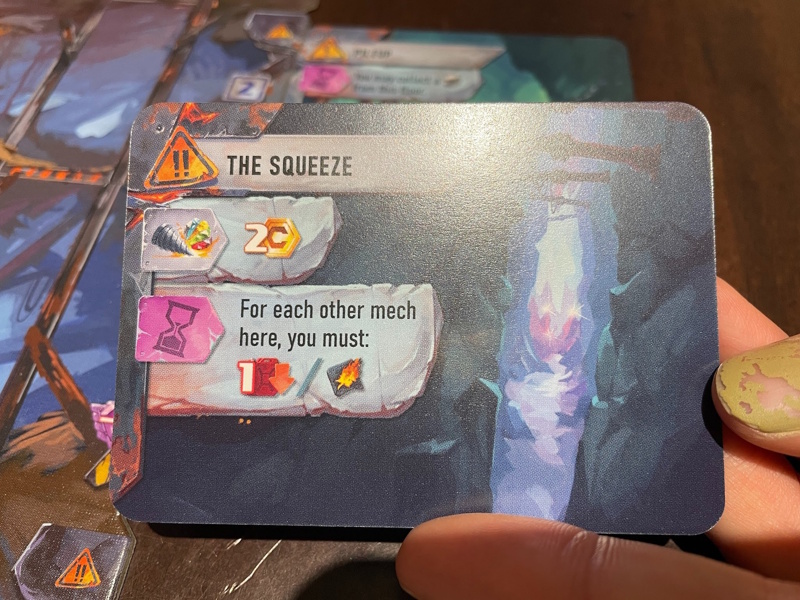 An example of a floor card. This one grants money on a drill action, and at the end of the player’s turn, they must spend fuel or take damage for every other mech on the same floor.
Play Cards:
The cards in your deck are the most impactful factor to your success. With them you can either use them to gain fuel, or you can spend fuel to gain their effect.
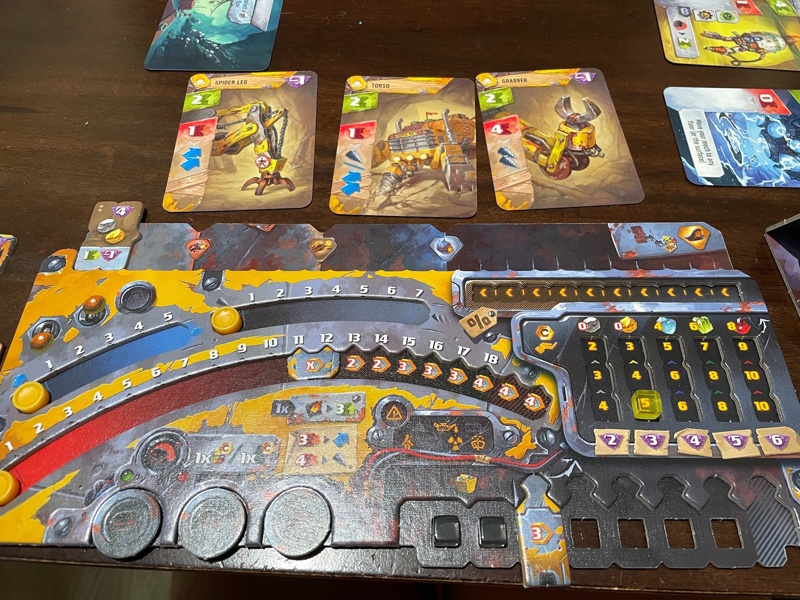 Cards present in the play area in front of a player’s dashboard.
If you use a card for fuel you add it to your play area and increase your fuel gauge to the amount shown on the upper left of the card, just below the name.
If you decide to use the card’s effect though, first spend the appropriate amount of fuel (shown on the card just below the fuel gain portion), add the card to your play area, then gain the effects of the card in any order you wish. Many cards will give you movement and drill points, shown below the fuel cost. To the right of that, other effects may be present, like giving you money, adding damage to your deck (add a damage card to your discard pile), repairing your deck (remove from your deck a card from your hand, play area, or discard pile), drawing a card, and more. Some cards will also have a main effect at the bottom of the card, which may trigger upon playing, or later in the turn.
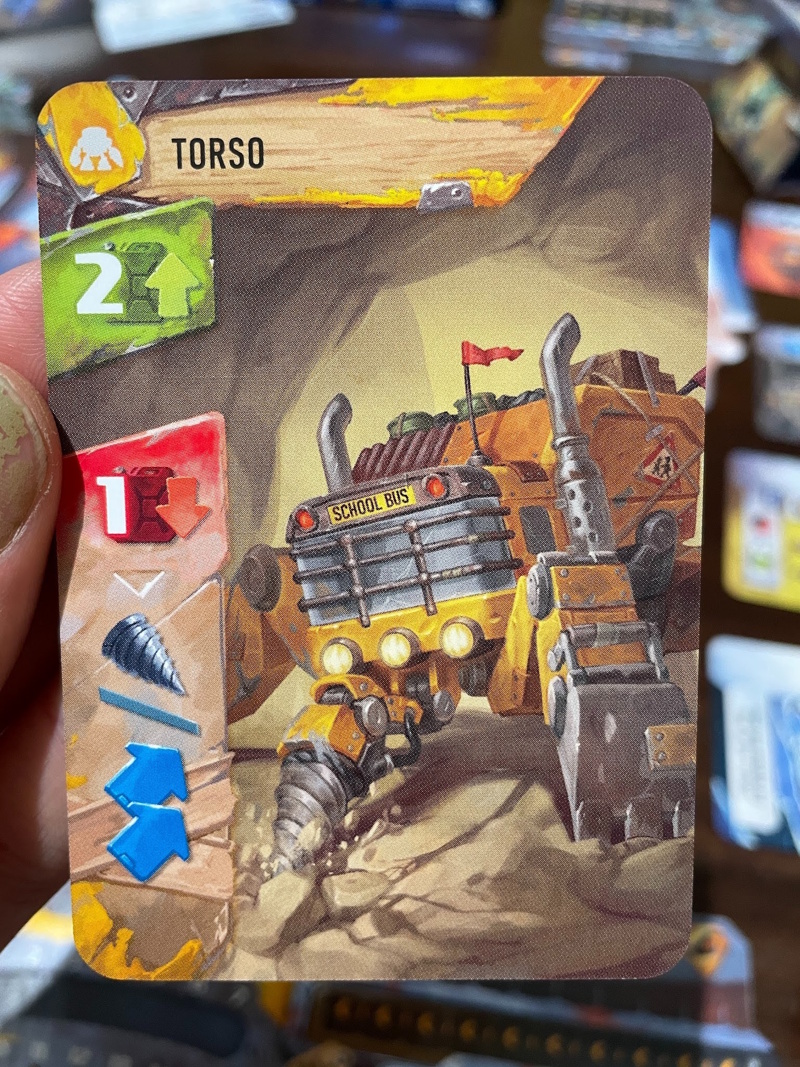 The Torso card that starts in every player’s starting deck. This one is for the yellow player.
Players can also hold onto cards in their hand for the Surfacing phase, or for their next turn.
Other Actions:
In addition to spending fuel for movement, drilling, and playing cards, a player may, once per turn, take damage (add a damage card to their discard pile) to immediately gain three fuel.
Players can also flip over mine tiles on their progress track for one time benefits at the cost of some end game points. These can grant movement, drilling, fuel, or most critically, batteries, which are used in purchasing advanced cards in the Surfacing phase.
Drones:
During the Operations phase, a player may also flip over an active drone token on their dashboard to take one of two different actions related to the Surfacing phase.
- Sell one mineral: selling a mineral grants the player an amount of money and clears out a space in their storage, which can be impactful for turns where the player wants to collect just one more mineral.
- Buy one card: the player picks one card in the market to spend money to add to the top of their deck. This can be very important for turns where the player cannot make it back to the surface for the Surfacing phase of their turn.
Surfacing
If a player ends their Operations phase on floor 0, they then can perform actions in the Surfacing phase. Otherwise, they will skip this phase. In this phase, players can perform the following actions:
- Sell minerals: When selling minerals, players will remove the mineral tokens they have in their storage to an empty slot in its corresponding column in the market table on their dashboard. These columns fill up bottom-up, and each slot will specify the amount of money gained from adding the mineral to the slot. Once a column is full, any excess minerals of that type gets added to the overflow row, now granting a consistent amount of money for each mineral added.
- Discard cards for money: if the player saved any cards from the Operations phase, they can discard any number of them for two money each.
- Repair: for the cost of five money, a player can take the repair action once per turn. Repairing involves picking one card from your hand, play area, or discard to remove from your deck. If you repair a card from your hand, you draw a new one to replace it. It’s always best to repair damage cards and cards that were in your starting deck, as they are inefficient and inflict negative points at the end of the game. Removing the right cards can also make your deck more reliable, enabling you to see your more powerful cards more often.
- Buy new cards: at the start of each turn, the market will be filled with two revealed cards for each category of card that can be purchased (four for advanced cards once floor 4 is unlocked): drilling (cards that focus on granting drilling points or make drilling easier), movement (cards that focus on granting movement points or make movement easier), utility (cards that grant various effects, like refreshing drones, drawing cards, or repairing), and advanced (the best cards possible that have very powerful effects). The cost of the card is listed in the upper right of the card, usually costing some amount of money. Advanced cards will require at least one battery to buy them, however. These are only available from mine tiles, further incentivizing players to excavate corridors and remove barriers.
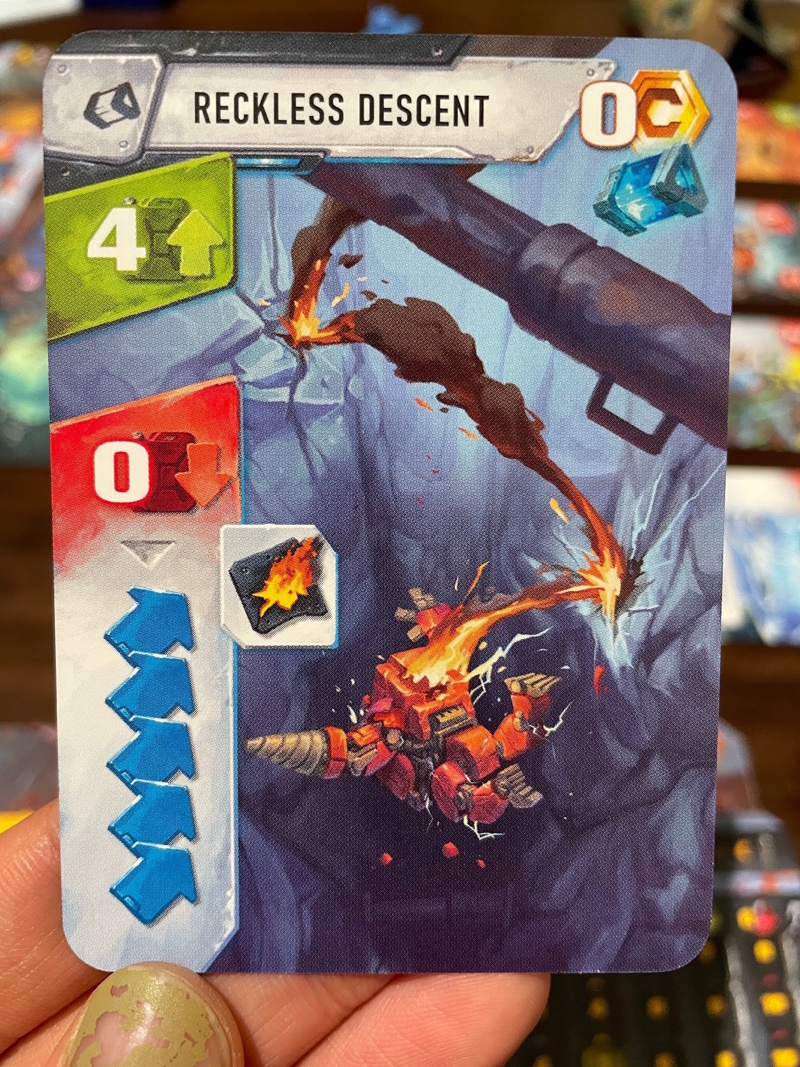 An example of an advanced card. It costs no money, but it does require one battery to purchase.
- Refresh Shop Tile: once per game, players can refresh the shop of one category, placing any revealed cards in that section of the market under the associated stack. Afterwards, new cards are drawn from the top of the same stack to completely refill that portion of the market.
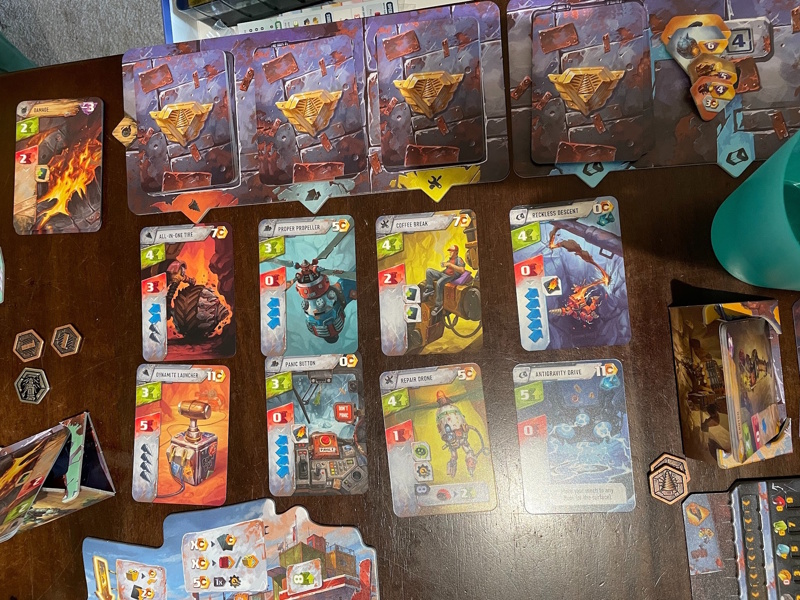 The shop where players can purchase cards. 2 of each category start revealed.
- Upgrade your Rig: players can spend money to upgrade their mech’s mineral and fuel storage. The cost is shown on the storage cap and the fuel gauge respectively.
- Refuel: set your fuel amount to your storage cap.
Upkeep
The last phase of a turn is the Upkeep phase. Here, the player first spends fuel to keep any cards they held onto for future turns. The first card is free, but every card afterwards costs one fuel a piece. Any cards not paid for goes to their discard pile. Then the play area is cleared: any cards played this turn are added to their discard pile, and any remaining movement and drill points are lost (set the respective gauges to zero). The player will then draw three cards from their deck. If their deck is empty, they’ll shuffle their discard pile to recreate their deck. Lastly the shop will get refilled if any cards were bought.
End of the Game
The endgame is triggered when a player’s progress track of mine tiles overlaps with their mineral market overflow row. That player then gains an ending game bonus (granting additional points) and won’t have another turn once this one ends. Every other player draws an additional card and has one more turn to score and/or escape the mines! The deeper in the mines a player ends their turn, the more of a points penalty they are inflicted with.
After the endgame sequence, scoring for each player is done as follows:
- Points from each mine tile collected.
- Points from minerals collected in storage, market, and overflow.
- Points for every five money.
- Points for milestones. These milestones include the ending game bonus, and being the first one to reach a certain amount of space filled on their progress track.
- Lose points based on how deep the mech is underground.
- Lose points based on cards left in the player deck with negative point values.
Whoever ends up with the most points wins!
Thoughts
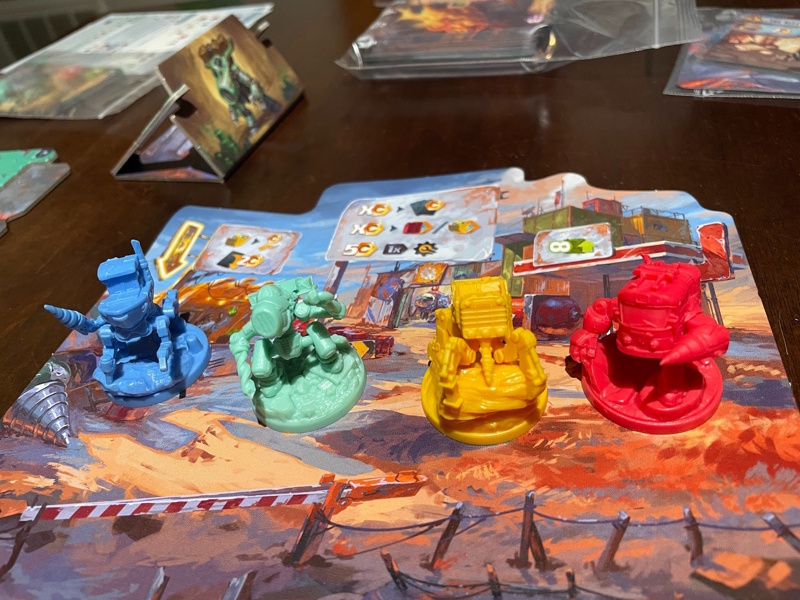 All the mechs, lined up.
Drillers is an incredible game chock-full of difficult, opportunity costing decisions. Every choice you make requires careful planning and anticipation of your opponents' actions. Do you decide to spend your fuel to move up to the surface after mining a corridor, leaving behind precious minerals for your opponents to take away, or do you decide to stay underground, forfeiting the Surfacing phase to pick up the minerals left behind? Do you spend your drill points on corridors this turn, which will grant a lot of points, or the minerals on the floor, which will give you the money for a critical card?\
Despite the difficult decision making, the keeping track of resources (minerals, fuel, drilling, and movement) is done super easily with the dashboard. Additionally, the visual design of the cards are large, clear and consistent. As a result, it is your decision-making, not the components of the game or visual-readability, that occupies your attention. This makes Drillers a game I’d put on par with Wingspan when introducing players to more complex board games after consistent play of a modern classic like Azul or Splendor. However, because of how players can affect each other’s decisions due to their actions, and because every choice has such a big opportunity cost that keeps the game really interesting, I think this game will find a permanent spot on the shelves of many avid board gamers.
If you’re a group of friends looking for a new game for board game night, or an avid board gamer looking for your next mainstay game, I really recommend Drillers
Drillers is available now from our webstore.