Square One
review by Alapai
Square One is an engine-building game for 1-4 players made by Boardcubator. In it, you collect tiles representing shapes in order to fill up sequence cards so that you can be the player with the most points by the end of the game.
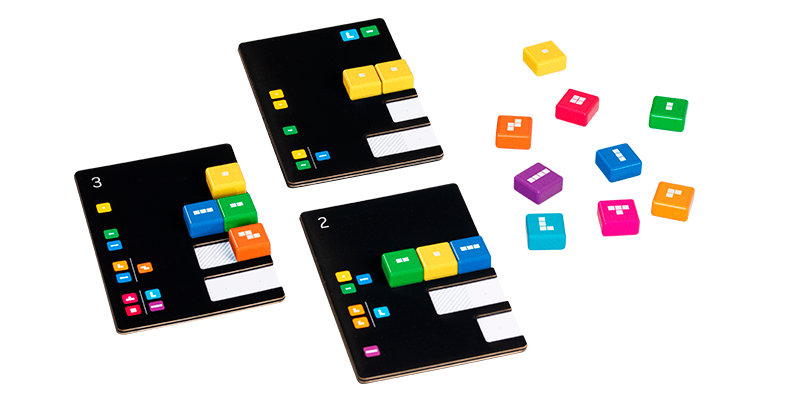
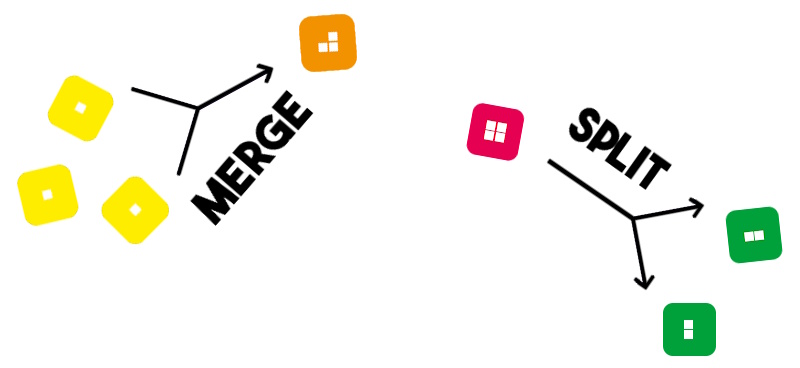
To setup the game, you shuffle the two decks of sequence cards, white and black. Next, you remove a number of black cards based on the number of players (more removed for less people) and put them back in the box. You then create two rows of sequence cards, 4 each of white and black). Each player is then given 3 tiles, 2 yellow level 1 tiles and 1 green level 2 tile. Each round consists of each player taking a turn. Each turn, you take 3 actions, consisting of any combination of Gain, Take, Place, Merge, Split and a Master Action. The Gain action gives you a yellow level 1 tile from the reserve. The Take action lets you take one of the 8 sequence cards from the marketplace, replacing it immediately with one from the top of the deck. The Place action lets you fill up the top row of one of your cards with the appropriate tile(s). The Merge action lets you merge any of your tiles together to gain a tile of the level of the combined tiles (ie turn your 2 level 1 tiles and 1 level 2 tile into a level 4 tile). The Split action lets you split a tile into multiple tiles whose combined level is the total of the original (ie turn your level 4 tile into 2 level 1 tiles and 1 level 2 tile). The Master Action is limited to once per turn and lets you fill up to one row on each of your cards. Whenever you fill up one of your cards, you get back the tiles you used to fill it up and gain the reward from the top of the card (tiles from white cards and victory points from black cards). White cards get discarded into a discard pile while black cards get kept face down in a player’s score pile. If multiple cards were filled at the same time from the Master Action, you gain combo points as well. Once the last black card from the deck is placed into the marketplace, you finish the current round and one final round. Then, you count up all the points from black cards and combo tokens and whoever has the most is the winner!
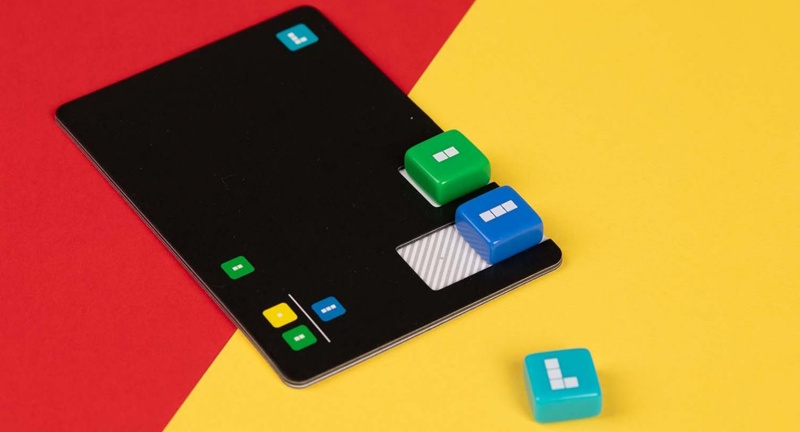
Square One falls into a genre of game known as engine-building where you spend your time in a game building up an engine that allows you to take more powerful actions as you get further into the game. You start with a very small amount of components, but as you progress, you start gathering more resources and then can use those to get more resources and eventually you can gain the victory points that are the end goal of the game. Engine-building games often feel weird at the start of the game, as your actions feel very limited early on. For example, the Split action can technically be used as your first action of the game to split your level 2 tile into 2 level 1 tiles, but you probably won’t actually want to use the Split action until you have 3 or 4 cards out and a bunch of level 3 and 4 tiles that you need to split to fulfill some cards when you currently have all your lower level tiles already on cards. I find engine-builders interesting as I often want to play them a couple times when first learning them in order to first understand the rules and once I know those, use those to understand the strategy. There will often be some confusion the first time playing as you wonder why you take any of the actions, but once it clicks, I like to play a new game where you understand it from the start.
One thing I think makes Square One stand out from some of the other engine-building games is that you keep all of your components as you go. In games like Splendor or Century: Spice Road, you are accumulating the various resources and then spending them to purchase cards. While cards in Splendor help reduce the cost of future cards, you are generally still spending tokens when purchasing more expensive cards. In Square One, you take back all the tiles you used to complete a card, allowing you to complete future cards faster. While you’re not starting all the way back at the beginning each time you obtain victory points in Splendor or Century, you do lose all the resources you were acquiring by spending them. In contrast, Square One has you putting your resources aside while acquiring a card, getting them all back when you finish a card which makes it feel like a more powerful engine.
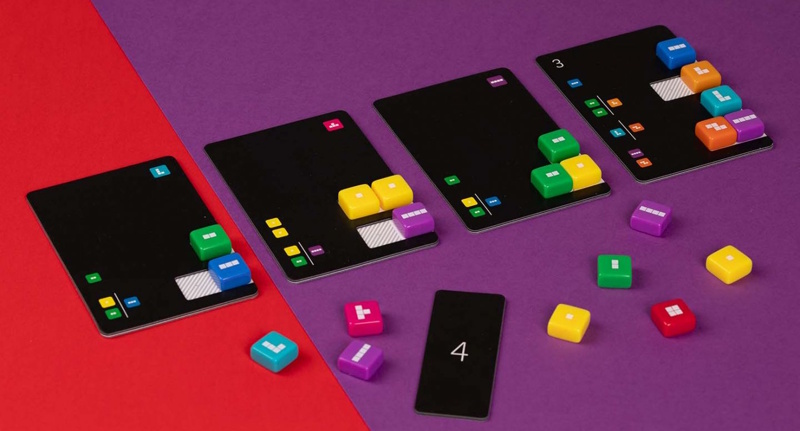
I enjoy Square One quite a bit. I’ve really liked playing engine-building games in general and Square One is able to scratch that itch while adding just enough uniqueness. Square One is a spiritual successor to another of Boardcubator’s games, Project L. The main difference between the two is that Project L plays more like a puzzle game where you have to fit pieces of various shapes together to fill out a shape properly while Square One just asks you to have specific pieces at different times. Otherwise, both have you taking tiles to place onto cards in order to earn victory points and additional tiles.
Square One also has a solo mode where you try to earn more victory points than an AI taking its own turns. In it, you play as normal, but you play against an AI that takes its own version of the actions. Depending on how tricky you want it to be, you can choose between three different difficulty settings, changing how many actions the AI can take on a turn. Having played a bunch of different solo modes against an AI, I do generally prefer an AI that is unpredictable. Star Wars: Outer Rim for example uses an AI deck that will dictate its actions for any given turn. In comparison, Square One’s AI just looks at what is currently out and what pieces it has available to determine whether it takes more cards or earns the rewards for the cards its already taken. The AI mode is fine, but I do prefer playing against an actual person.
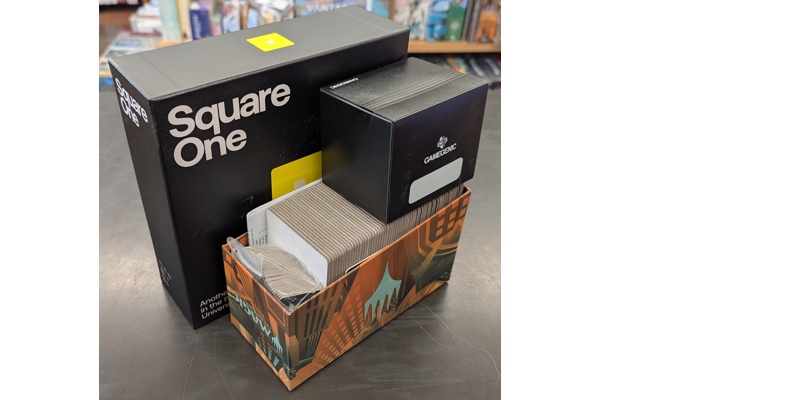
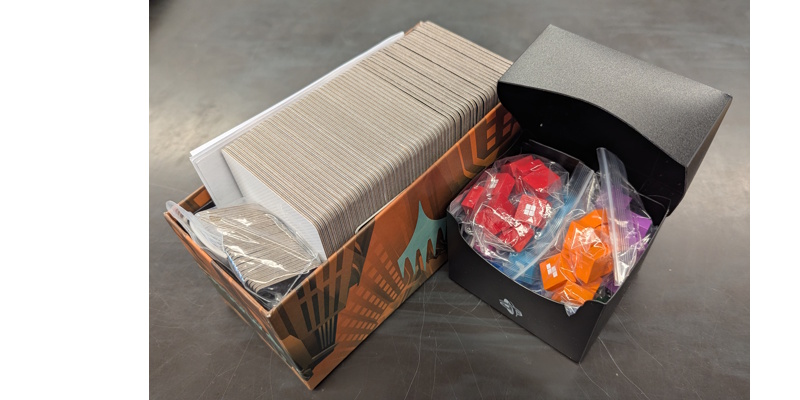
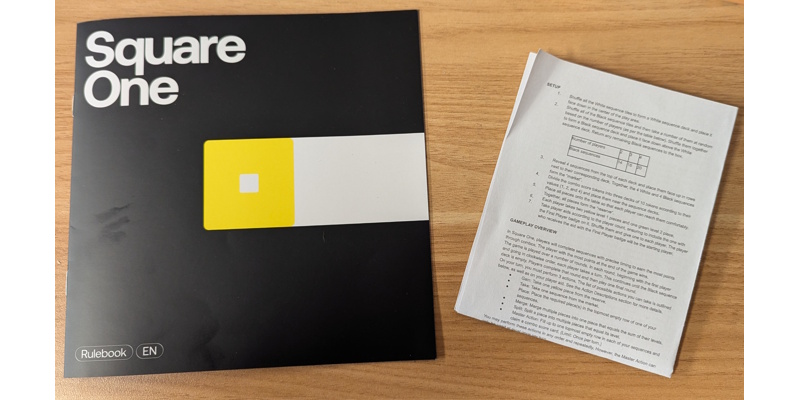
While not as extreme as some other games I’ve already reviewed this year, I’m not a huge fan of Square One’s box. In order to make it more condensed, I took the cards and put them into an empty Magic: The Gathering Bundle box and put the tiles into a 100+ deck box. I also made a version of the rules that can fit on one piece of paper and printed that out to fit in the box with the rest of the game.
If you’re looking to get a fun engine-building game where you keep adding to your engine, only losing resources temporarily in order to get more, Square One is a great addition to a board game collection.
Square One is available now from our webstore.